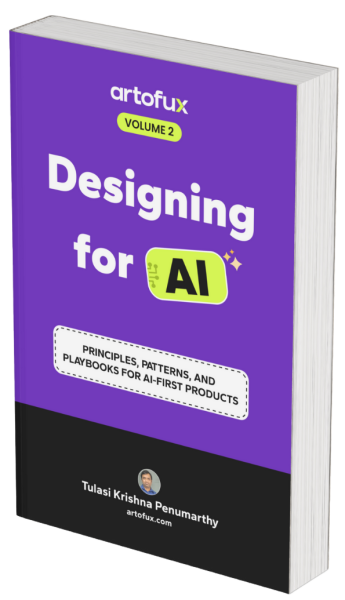
The Only UX Guide You Need to Design AI-First Products
Designing for AI is different. Here’s how to get it right
- Learn how to design for LLMs, agents, and unpredictable outputs.
- Make AI explainable, usable, and trustworthy — without guesswork.
- Build interfaces that adapt, evolve, and still feel intuitive.
- Upgrade your UX skills for the next generation of products

By Tulasi Krishna Penumarthy
13 years in UX. From SaaS workflows to AI-first systems - I’ve made every design mistake so you don’t have to.
24
Confused by AI Hype? This Book Delivers Real Design Guidance
Designers, Not Data Scientists
- You don’t need to code models—just learn how to design around them
- Discover frameworks that make AI behavior understandable to users
- Stay relevant in a world where intelligence shapes the interface
Real Projects. Real Lessons.
- Learn from actual AI product design - failures, pivots, and breakthroughs
- Avoid common design traps around trust, feedback loops, and opacity
- See how teams redesigned features after AI broke their perfect UX
No Theory. Just Tools You Can Use
- Get practical patterns, principles, and playbooks - not fluff
- Use ready-to-go checklists, model contracts, and UX methods
- Apply everything directly to your next AI-powered feature
For Designers Who Want to Lead in the AI Era
- Build alignment between design, data, and ML teams
- Communicate clearly when outputs vary or confidence is low
- Shape systems that learn and respect human agency
Inside "Designing for AI": Your Roadmap to design AI-First Products
How to design for unpredictable AI outputs?
- Embrace variation instead of fixed results
- Show confidence levels and possible outcomes
- Design graceful fallback and recovery states
How to build user trust in intelligent systems?
- Calibrate trust with visual confidence cues
- Offer explanations only when they matter
- Let users override or opt out easily
How to handle AI uncertainty in the UI?
- Show when the system is unsure
- Avoid pretending certainty where none exists
- Normalize ambiguity as part of the UX
How to design Human–AI collaboration flows?
- Choose the right pattern: assist, co-create, or delegate
- Clarify roles between user and AI
- Let users stay in charge at all times
How to work with data as a design material?
- Spot gaps, bias, and blindspots early
- Design flows that improve through feedback
- Turn messy data into meaningful UX
How to make AI systems more explainable?
- Use “Why this?” prompts where it matters
- Layer complexity through progressive disclosure
- Avoid overwhelming users with raw logic
How to design for systems that keep learning?
- Show when the system evolves or adapts
- Update mental models through subtle cues
- Build in feedback without adding friction
How to design fair and inclusive AI products?
- Test across diverse user groups and cultures
- Audit models for equity, not just accuracy
- Support accessibility beyond visual UI
How to rethink error handling in AI UX?
- Frame errors as variation, not failure
- Offer human-friendly fallback paths
- Preserve user dignity during AI mistakes
How to align design with ML and data teams?
- Create shared model + UI documentation
- Define what the AI will return and when
- Make behavior part of your spec, not an afterthought
How to stay relevant as a designer in the AI era?
- Learn to design behaviors, not just screens
- Build data and governance fluency
- Lead with clarity in uncertain environments
Tulasi Krishna Penumarthy
Author "Art Of UX"
Product Design Leader, Founder of DevForce Soft Labs Pvt. Ltd.
A Product Designer with over a decade of experience in the tech industry. My journey began as a Software Engineer at Syntel Inc in 2011, where I gained valuable insights into corporate dynamics and team collaboration.
My entrepreneurial spirit led me to co-found two startups. My first venture was a software development and marketing services company co-founded with my college buddies, followed by ApnaLoanBazaar, where I contributed to product design and development. These experiences, coupled with my work assisting other startups, allowed me to discover my true passion and talent for UI/UX design.
In 2015, I founded DevForce Soft Labs Pvt Ltd, initially to support my self-coded product, Skillholic. The company soon pivoted to become a full-scale UI/UX design agency, which I have led for over eight years. DevForce has served clients across India, USA, UK, Australia, Qatar, and Germany, specializing in industries such as SaaS, Finance, Healthcare, EdTech, AI, Automotive, and EV.
More recently, I served as Director of Product Design at Mobius, an AI-first low-code platform, where I led the design strategy across intelligent agents, no-code tools, and dynamic UI generation systems. This role deepened my expertise in AI-powered product experiences, knowledge graphs, and design systems for scalable enterprise environments.
My diverse background spans software development & QA, entrepreneurship, and design leadership, giving me a unique perspective on product design and SaaS.
After publishing my first book, Art of UX, which focused on practical UX strategies for SaaS product teams, I’ve continued helping designers navigate the evolving demands of modern product design. Now, with my second book, Designing for AI, I’m diving into the challenges and opportunities of building human-centered experiences for intelligent systems. My goal remains the same: to share proven, real-world methods that empower designers to stay ahead – this time, in a world shaped by AI.
5137 screens already designed for 126 happy customers!
Frequently Asked Questions
Absolutely. Designing for AI is written specifically for designers – not engineers or data scientists. It breaks down complex concepts into practical, design-focused guidance, so you can confidently work with AI systems even if you’re new to the space.
Most books focus either on UX or on AI as a technical field. This book sits at the intersection—showing how AI changes design fundamentals, and giving you patterns, principles, and playbooks tailored to AI-first product development.
This book is built from real-world projects and battle-tested approaches. It includes frameworks, examples, and actionable tools you can apply directly to your current or next AI-powered product.
Yes! While it’s written for designers, the book is also highly valuable for PMs, founders, and engineers working on AI products. It helps you understand design considerations around trust, feedback, data loops, and team collaboration.
The book assumes you’re a designer or product thinker—not an ML engineer. It explains AI behaviors, patterns, and collaboration methods in plain language, making it approachable even if you’re just starting out in AI.
Yes. It includes practical checklists, model contract examples, design documentation tips, and patterns you can adapt to your own workflow.
Yes. The book reflects current practices and challenges faced by teams building with large language models, real-time feedback systems, and generative AI tools as of 2025. It’s designed for the landscape we’re in right now.
Reach out directly at tulasi@artofux.com. This book is just the beginning of a growing community of AI-aware designers.